Hearing loss in early childhood after passing newborn hearing screening
A Pass Is a Snapshot
Background
Every newborn in the Netherlands is offered a hearing screening. It has up to three rounds. The first two use otoacoustic emissions (OAE), and a baby who does not pass twice gets a third test with automated auditory brainstem response (AABR). A baby who passes any round receives no further screening. The programme reaches more than 98% of about 167,000 newborns a year and identifies roughly 200 infants with sensorineural hearing loss (SNHL) annually. That is a real success: early detection allows early intervention, and early intervention improves speech and language development.
Yet in clinic we regularly see toddlers and preschoolers with clear sensorineural hearing loss whose screening result was a pass. In our new paper (Smetsers et al., 2026), led by Iris Smetsers with Noëlle Uilenburg, Ronald Pennings, and Froukje Cals, we asked how many such children there are, what their hearing loss looks like, and what causes it.
What we did
We reviewed the records of all children younger than five years who were seen at Radboudumc between 2014 and 2024 for etiological work-up of sensorineural or mixed hearing loss with an unknown cause and who had passed their newborn screening. We obtained the official screening results per ear and per round from the National Institute for Public Health and the Environment (RIVM). 119 children (205 ears) were included.
Because these children were referred for etiological diagnostics, the age at which the hearing loss began could not be determined. We know only the age at referral, which averaged 3.4 years, and nearly three-quarters of the children were older than three. This is an important limitation. We cannot distinguish a hearing loss that was present but mild at birth from one that began later.
A substantial group
Over eleven years, about 11 children per year passed the screening in both ears and were later seen in our centre with SNHL. Our centre sees roughly a fifth of such cases nationally, so we estimate that about 50 children per year in the Netherlands present with SNHL before the age of five despite a pass. That estimate is probably low, because it includes only children referred for etiological evaluation.
For comparison, the screening itself identifies about 219 children with hearing loss of 40 dB or more each year (RIVM, Monitor Neonatale Gehoorscreening 2024). About 50 missed children next to about 219 detected means that roughly one in five children with SNHL before the age of five had passed the newborn screening. That is close to the 19% that Korver et al. (2010) reported for Dutch children with permanent hearing loss at age three to five.
These are not children with trivial hearing problems. Three-quarters had abnormal speech and language development, mostly delayed and in some cases stagnated or absent.
Heterogeneous hearing loss and causes
The hearing loss varied widely. About a quarter of ears had a mild loss, but moderate, severe, and profound losses also occurred. All audiogram configurations were represented. Where follow-up audiometry was available, the loss often progressed.
An etiological diagnosis was found in 62% of children. Genetic causes were the largest group, with a wide range of genes involved, followed by cochleovestibular malformations (mainly an enlarged vestibular aqueduct) and congenital CMV infection.
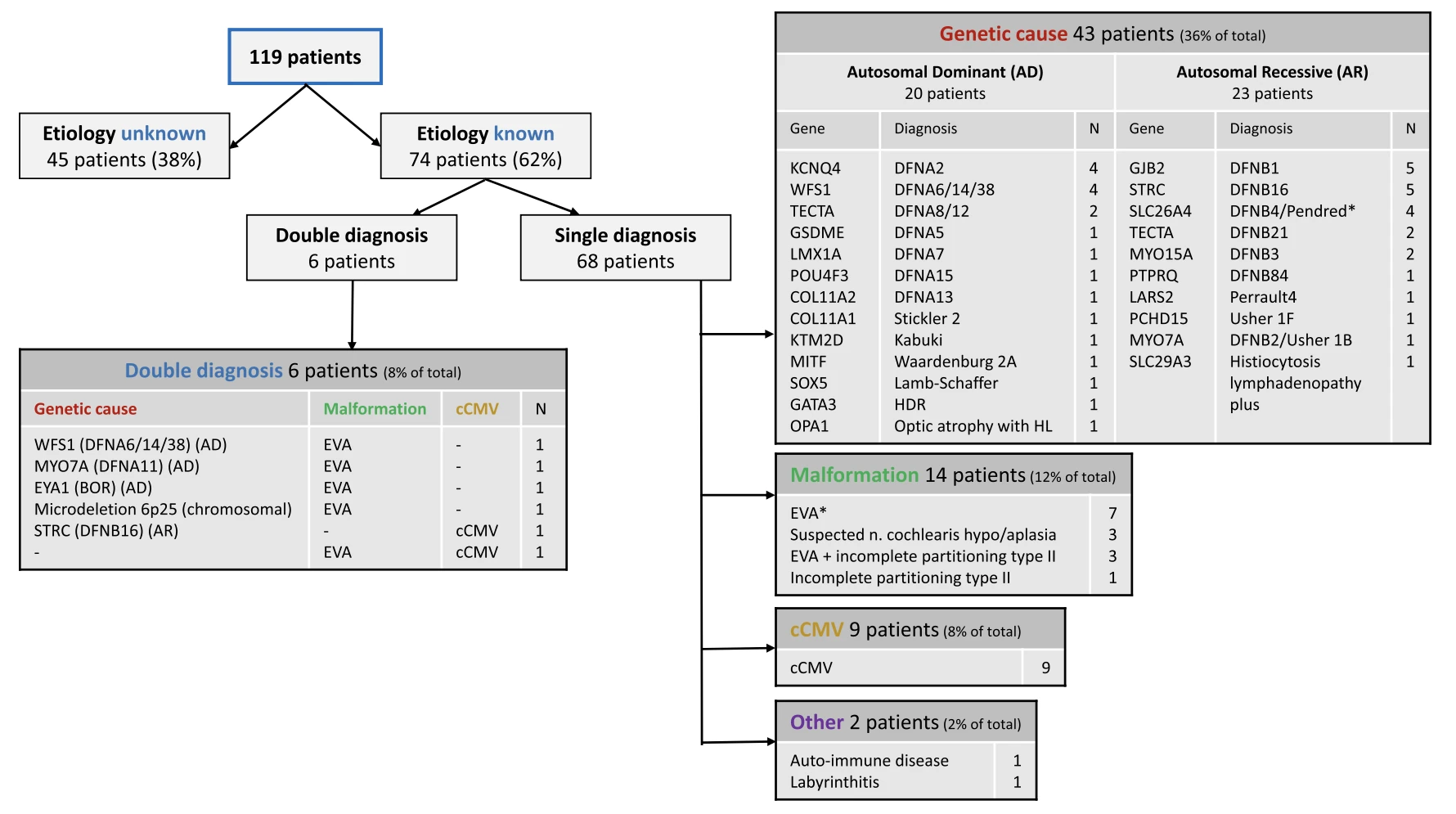
This diversity is itself a finding. No single test or gene panel would have found all of these children at birth.
Why did they pass?
We found no evidence of false-negative screening results. The more plausible explanation is that the screening is a snapshot. It is designed to detect hearing loss greater than about 35–40 dB on the day it is performed, and it does exactly that. It is not designed to detect:
- mild hearing loss, which falls below the screening threshold, and
- progressive or early-onset hearing loss, which is absent or mild at birth and becomes clinically relevant months or years later.
Many of the causes we identified are known to progress. Autosomal dominant genetic hearing loss is often mild at first and progressive. An enlarged vestibular aqueduct can cause fluctuating and progressive loss, and congenital CMV can cause late-onset hearing loss. Because we do not know the true age of onset, we cannot prove this directly. We think, however, that part of what we call “congenital” hearing loss is better described as early-onset: the cause is present at birth, but the hearing loss is absent or mild on the day of screening.
The third round stands out
The finding that surprised us most concerns the third round. Nationally, only about 2,300 of 167,000 newborns (roughly 1 in 70) pass the screening in the AABR round. In our cohort, 36% of ears passed in exactly that round.
Children who pass only in the third round are therefore strongly overrepresented among those who later present with hearing loss. That makes sense: a baby who did not pass OAE twice already showed a signal that something might be wrong, even though the final AABR result was a pass. There is also a technical factor. Ears with a mid-frequency hearing loss were more likely to pass with AABR than with OAE, probably because the broader frequency range of the AABR stimulus can still produce a response.
What does a pass mean for an individual child?
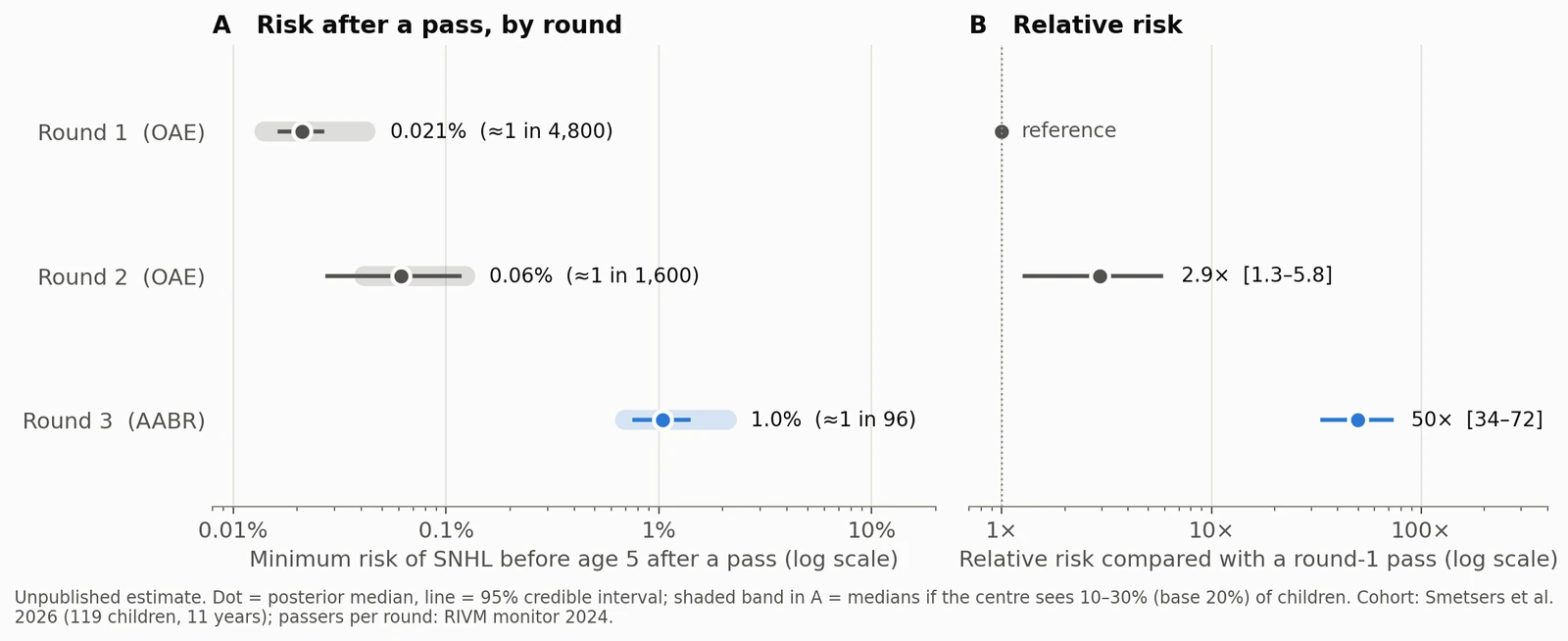
The paper describes the children who were missed. Parents want the reverse: after a pass, how likely is it that hearing loss still turns up? We can estimate this by combining our cohort with the national screening figures. This analysis is our own and has not been published. It rests on assumptions that are listed below.
The numbers
| Round 1 (OAE) | Round 2 (OAE) | Round 3 (AABR) | |
|---|---|---|---|
| Children passing per year (RIVM 2024) | ~153,000 | ~5,700 | ~1,900 |
| Ears in our cohort that passed in this round | 105 (59%) | 10 (6%) | 64 (36%) |
| Children in our cohort, estimated | 70 | 7 | 43 |
| Estimated national number per year | ~32 | ~3 | ~20 |
| Minimum risk of SNHL before age 5 | 0.021% (0.017–0.026) | 0.06% (0.03–0.12) | 1.0% (0.77–1.38) |
| Roughly 1 in … | 4,800 | 1,600 | 100 |
| Relative risk vs round 1 | 1 (reference) | 2.9 (1.3–5.8) | 50 (34–72) |
Values in brackets are 95% credible intervals. A pass in round 3 also carries about 17 times the risk of a pass in round 2 (8–39).
How we calculated it
- Cases per round. The paper reports the passing round per ear (105, 10, and 64 of the 179 ears with a known result). We applied these proportions to all 119 children. The paper does not give a split per child.
- From our centre to the country. We assumed that our centre sees about 20% of these children nationally, over the 11-year study period (2014–2024). That gives about 54 children per year, in line with the paper’s estimate of about 50.
- Denominators. The numbers of children passing each round per year come from the RIVM monitor 2024, standard OAE–OAE–AABR protocol only, matching the cohort. Round 1: 161,364 OAE screens, 5.2% referred. Round 2: 8,057 OAE screens, 29.8% referred. Round 3: 2,392 AABR screens, 20.6% referred. The monitor’s refer figures are counted per child, while our cohort counts the passing round per ear. A child whose ear passed in round 1 but whose other ear went on to round 2 is therefore counted slightly differently in the numerator and the denominator.
- Model. For each round we used a beta-binomial model with a uniform prior: the observed cases in our centre against 20% of the national number of children passing in that round, over 11 years. The relative risks are ratios of the posterior samples.
How robust is it?
The absolute risk depends mostly on the assumed share of children our centre sees. For a pass in round 3, the estimate is 2.1% if our centre sees 10% of these children, 1.4% at 15%, 1.0% at 20%, 0.8% at 25%, and 0.7% at 30%. The relative risk does not depend on this assumption, because it scales both rounds equally. The choice of year does matter somewhat. Our cohort spans children born from about 2009 onwards, and around 2,300 children a year passed in round 3 on average over 2006–2023 (paper, Fig. 1), against 1,900 in 2024. With those long-term averages, the risk after a round-3 pass is 0.9% (about 1 in 115) and the relative risk is about 43 (29–62). The difference between the rounds is therefore the more robust finding.
All of these are minimum estimates. They count only children who reached our centre for etiological work-up and whose cause was not yet known. Children who were never referred, children diagnosed elsewhere, and children with an already known cause (for example, congenital CMV found at birth) are missing. The true risk after a pass is therefore higher. Settling it properly requires prospective follow-up of children who pass, stratified by screening round.
What this means in practice
1. Normal hearing depends on the moment of testing. A pass means the hearing was sufficient on the day of screening. It does not guarantee normal hearing later in childhood. This has changed how we counsel parents. The message is not to worry, but to stay alert, including after a pass.
2. A pass in the third round deserves extra attention. At least about 1 in 100 of these children is later diagnosed with SNHL, roughly 50 times the risk after a first-round pass. The group is also small enough to follow up: about 1,900 children a year. A targeted second hearing screening around the age of two is a realistic option for them.
3. Family history matters. A positive family history in a first-degree relative was twice as common in children with a genetic diagnosis (40% vs. 19%). These children are also candidates for targeted follow-up.
4. Take parental concerns seriously. Three-quarters of the children had abnormal speech and language development. Children with a developmental delay, or whose parents are worried about their hearing, should receive a full audiological evaluation, whatever their screening result.
Screening all Dutch children a second time is probably neither feasible nor cost-effective. Targeted follow-up of children who passed in the third round, children with a positive family history, and children with developmental concerns may be a pragmatic alternative. Prospective studies are needed to find out how many children such an approach would detect earlier and whether it improves their outcomes.
References
-
Smetsers, I. E. C., Uilenburg, N., Pennings, R. J. E., Lanting, C. P., & Cals, F. L. J. (2026). Sensorineural hearing loss in early childhood after passing newborn hearing screening. European Archives of Oto-Rhino-Laryngology, 283(10), 6391–6402. https://doi.org/10.1007/s00405-026-10435-1
- Korver, A. M. H., Konings, S., Dekker, F. W., Beers, M., Wever, C. C., Frijns, J. H. M., Oudesluys-Murphy, A. M., & DECIBEL Collaborative Study Group. (2010). Newborn hearing screening vs later hearing screening and developmental outcomes in children with permanent childhood hearing impairment. JAMA, 304(15), 1701–1708. https://doi.org/10.1001/jama.2010.1501
- RIVM. Monitor Neonatale Gehoorscreening door de jeugdgezondheidszorg 2024. Rijksinstituut voor Volksgezondheid en Milieu, Bilthoven. https://www.pns.nl/documenten/monitor-neonatale-gehoorscreening-door-jeugdgezondheidszorg-2024. Source of the national numbers screened, referred, and passing per round.