

Audiological safety and outcome measures in Phase 1/2 trials for inner-ear therapies
Clinical Trials & Inner-Ear Therapeutics
The inner ear is increasingly a target for pharmacological and genetic intervention — and robust audiological measurement is essential. Small-sample first-in-human trials demand outcome measures that are sensitive enough to detect signal in individual ears, reproducible across test occasions, and interpretable against a detailed audiological baseline. This research line focuses on what to measure, how to measure it, and how to interpret results in that context.
Why this matters now
Gene therapy for hereditary hearing loss is moving from animal models to human trials. Several programmes targeting OTOF, GJB2, TMPRSS3, and other genes are currently in Phase 1/2 or in advanced preclinical stages. The audiological measurement problem for these trials is non-trivial: trial participants typically have severe-to-profound hearing loss with limited residual function, the expected treatment effect is a partial restoration of cochlear hair-cell or supporting-cell function, and the measurement window after treatment is narrow. Developing, standardising, and validating audiological endpoints for gene therapy trials — including speech perception (in noise), electrophysiological indices, and functional hearing outcomes — is a core near-term priority of this research line.
Completed work
Phase 1 trial — AC102 for sudden sensorineural hearing loss
The AC102 Phase 1 trial (2019–2022) was conducted at Radboudumc as a sponsor-driven investigator-initiated study together with Audiocure with myself as audiological co-investigator. The trial assessed the safety, tolerability, and pharmacokinetics of a single intratympanic injection of AC102 — a candidate treatment for sudden sensorineural hearing loss — in normal-hearing volunteers. Audiological safety monitoring covered a broad battery: pure-tone audiometry, speech perception, otoacoustic emissions (OAEs), and electrophysiological measures, tracked across pre-specified timepoints.
Results confirmed the safety and tolerability profile and provided the first human pharmacokinetic data for this compound, supporting progression to an efficacy-phase study (Lanting et al., 2025).
Cisplatin ototoxicity prevention
Cisplatin-based chemoradiation causes dose-dependent hearing loss that is often permanent. This work evaluated an intervention aimed at reducing treatment-related hearing toxicity in patients undergoing chemoradiation for head and neck cancer (Burger et al., 2024). The analysis addressed both audiological outcome measures and the practical challenge of monitoring hearing in patients undergoing active oncological treatment — a population that is difficult to test.
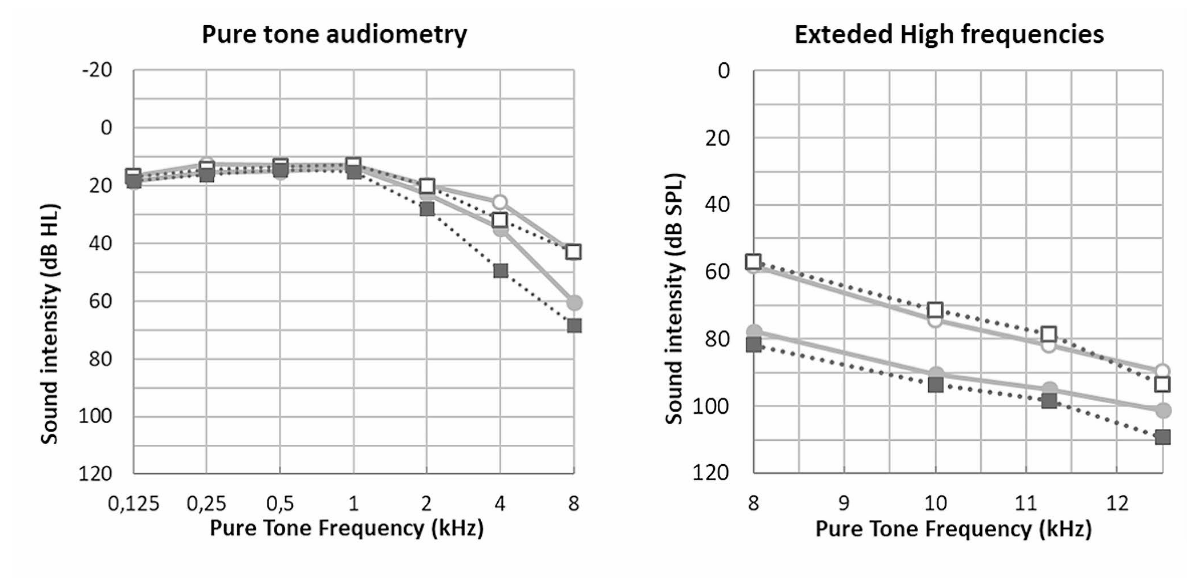 Figure. Baseline and follow-up average audiometry for both treatment groups, showing that the incidence of clinically relevant hearing loss of ≥ 10 dB at PTA 1-2-4 kHz was significantly higher in the triweekly CRT group compared to the weekly CRT group (42% versus 19%, p < 0.01),
Ototoxicity monitoring framework
A recurrent challenge across all inner-ear trial work is the absence of consensus on what constitutes a meaningful audiological change — particularly in the frequency region above 8 kHz, where ototoxicity (and early gene therapy effect) often first appears, but is often underreported as common scales (Brock, SIOP, see e.g. this link). Current work contributes to development of a standardised ototoxicity monitoring framework that integrates high-frequency audiometry, OAEs, and electrophysiology, compatible with both routine clinical use and trial-grade data quality requirements.
Planned and ongoing work
- Audiological endpoints for inner-ear gene therapy trials — collaborating with national and international teams (biotech companies) to define sensitive, reproducible endpoints appropriate for Phase 1/2 studies in populations with hereditary hearing loss
- Genotype-to-trial-eligibility mapping — building on natural history data from the Hereditary Hearing Loss and Genotype–Phenotype projects to identify which patients are most likely to benefit from specific gene therapy approaches and to predict the audiological window in which treatment-induced change could be detected
- Ototoxicity monitoring standardisation — contributing to consensus on high-frequency and electrophysiological monitoring protocols applicable across oncology centres and hearing research sites
Key references
Journal Articles
-
Lanting, C., Robijn, S., Nieratschker, M., Galetzka, C., Meis, A., Rommelspacher, H., Ahoud-Schoenmakers, S., Lackner, E., Zeitlinger, M., Bauer, M., Arnoldner, C., Pennings, R., & Schlingensiepen, R. (2025). Assessment of Safety, Tolerability, Pharmacokinetics, and Volume-Dependent Conductive Hearing Loss in Healthy Volunteers: First-in-Human, Open-Label, Placebo-Controlled Study of a Single Intratympanic Injection of AC102. Otology & Neurotology, 46(8), 884–894. https://doi.org/10.1097/MAO.0000000000004568
Posts & write-ups
-
Phase 1 Audiological Outcomes of Intratympanic AC102
Temporary High-Frequency Conductive Loss, Stable Cochlear Function